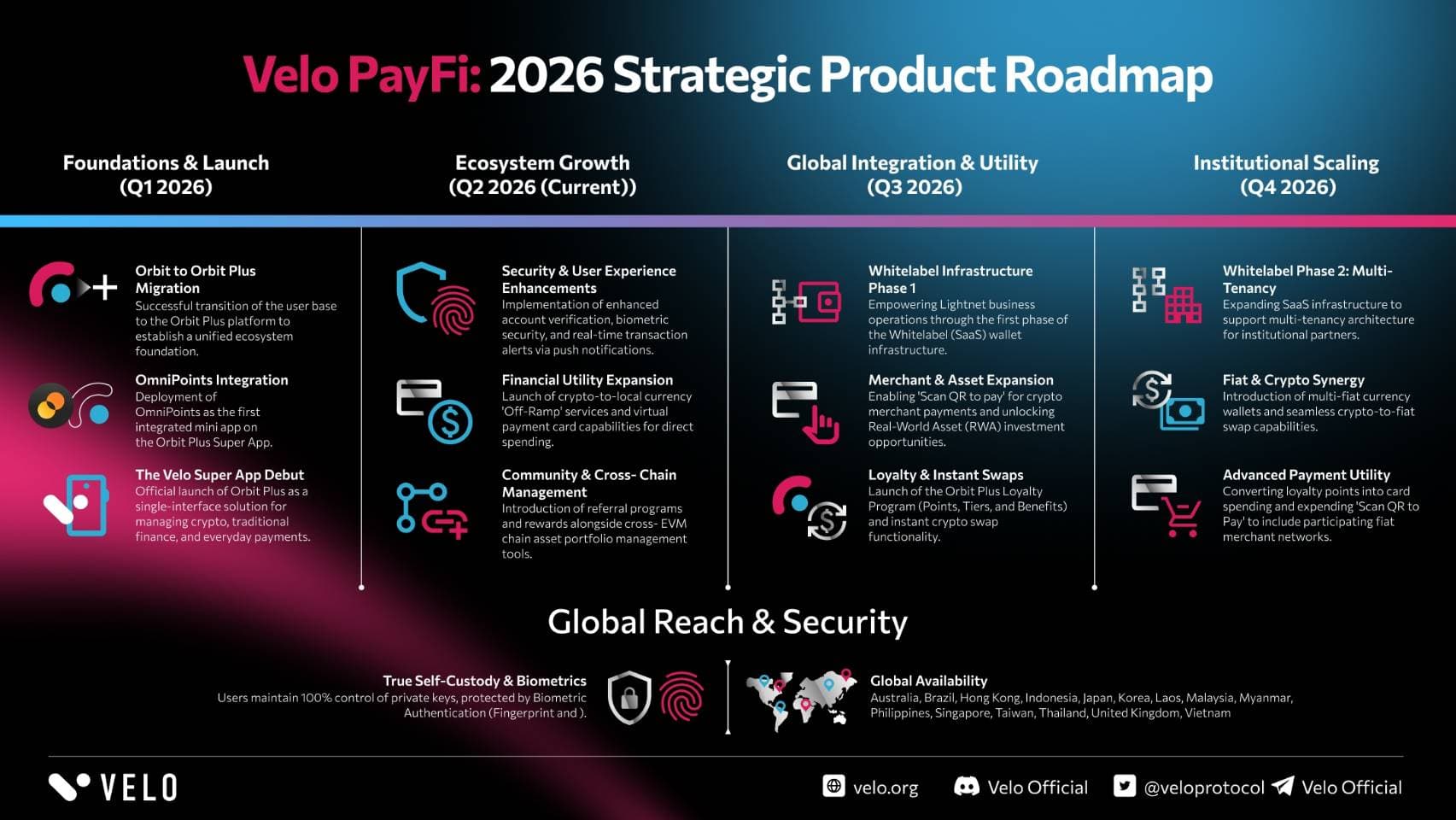
Velo PayFi: 2026 Strategic Product Roadmap
.png)
Velo 2026: The PayFi Network Where Licensed Rails Meet Crypto-Native Liquidity
The global financial system is still broken for anyone moving money across borders. Payments crawl through multiple intermediaries, capital gets trapped in pre-funded accounts earning nothing, and every jurisdiction adds another layer of compliance cost. The result is a system that's expensive, slow, and nearly impossible to scale.
Velo is building a better one.
By combining licensed fiat infrastructure with crypto-native liquidity, Velo is creating a full-stack PayFi network where money moves in real time, capital stays productive, and every transaction flows through a single programmable system.
Most crypto networks lack licenses. Most banks lack programmable liquidity. Velo combines both - and that's the whole thesis.
The 4-Layer Architecture
The Velo network is built as four layers that work together as one system.
At the foundation is the Compliance Layer, powered by Lightnet's established ASEAN network. This is what turns regulatory trust into programmable liquidity access - multi-jurisdiction licensing, compliant fiat collection and payout rails in local currencies, KYC/KYB/AML coverage, and regulated corridor access. This side of the equation cannot be replicated quickly. It takes years of work and significant capital across multiple country jurisdictions. It is Velo's moat.
On top of it sits the Infrastructure Layer — the chain-agnostic execution environment that powers global settlement. Multi-chain support across EVM-compatible networks (BSC, Solana, Polygon, Arbitrum, Optimism), institutional-grade MPC custody, and open APIs for enterprise integration. Clients and liquidity providers are never locked into a single chain, so the system can evolve alongside the broader infrastructure landscape.
The Capital & Settlement Layer is where money actually moves. Velo runs a hybrid liquidity engine that unifies CeFi and DeFi into a single execution layer - aggregating OTC desks, centralized exchanges, DEXs, and on-chain pools. A smart routing engine dynamically selects the best execution path based on price, slippage, speed, and cost. Every transaction flows through a stablecoin base settlement asset, captures the FX spread on conversion, and settles near-instantly. This replaces pre-funded nostro accounts and SWIFT-style settlement with on-demand, programmable liquidity - and because the engine also taps on-chain pools, it can reach frontier-market corridors that banks and OTC desks simply don't support.
Sitting above everything is the Treasury & Yield Layer, or what we call the Velo Treasury Operating System (TOS). This is where Velo goes beyond payments and starts optimizing balance sheets. Idle USD can be converted to USDT and deployed into yield strategies until it's needed, then routed out as local currency for payout - all within the same system, in real time. For institutional clients like MTOs, PSPs, and corporates, Velo offers this as Treasury-as-a-Service (TaaS): a managed layer that turns idle capital into productive capital. At scale, the network also introduces netting - aggregating bilateral flows across participants and settling only net positions, dramatically reducing liquidity requirements across the entire system.
How $VELO Captures Value
$VELO is not a payment token. It is the coordination asset that ties the whole network together, and it accrues value through three core functions.
Settlement Gas. Every FX and settlement transaction on Velo pays a small fee in $VELO. A percentage of those fees is used to buy $VELO back from the open market - creating a deflationary loop where higher transaction volume directly translates into higher demand and reduced circulating supply.
Liquidity Staking. LPs stake $VELO to participate in the network's transaction flow, provide depth on USDT and FX pairs, and earn yield from spreads and routing fees. More volume on the network means more LPs competing for flow, which means more $VELO staked - locking supply and aligning LP incentives with network growth.
Net Settlement Collateral. At scale, institutional participants lock $VELO as collateral to access the netting layer, enabling credit lines and capital-efficient settlement. This creates long-term lockup and institutional-grade utility.
In short: $VELO is consumed, locked, and reserved - and demand scales directly with real network activity. $VELO demand is not speculative. It is programmatically tied to volume, capital, and treasury usage across the network.
What's Coming Next
The first wave of this network lands in Q2 2026 through Orbit Plus, Velo's consumer and merchant-facing gateway. This quarter introduces a new whitelabel tech stack that lets partners launch their own branded payment apps, a virtual crypto debit card that spends your crypto balance instantly via Apple Pay and Google Pay, a direct off-ramp that sells crypto straight into your bank account as local currency, and deeper integration with AI entertainment ecosystems.
From there, Q3 brings real-world asset access, cross-chain swaps and transfers, crypto-to-merchant payments, and the launch of our first major whitelabel partner - proving the infrastructure works at scale. Q4 and into 2027, Velo opens up multi-tenant architecture for 100+ business tenants, loyalty programs, crypto-to-fiat merchant payments, and multi-fiat currency wallets that function like a global bank account.
In parallel, the liquidity and treasury layer matures from architecture and integration in Q2, to an MVP engine in Q3, a closed pilot in Q4 where clients hold balances inside Velo instead of pre-funding nostro accounts, and into commercial launch in early 2027 - with treasury vaults live, VELO staking active, and Treasury-as-a-Service open to institutional clients.
The Bigger Picture
Velo is not just building a payment network. It is building a financial system where licensed rails, on-chain liquidity, and treasury infrastructure operate as a single programmable whole - where every transaction creates value, every dollar in transit earns yield, and every participant is aligned with real network activity.
Payments were just the beginning.
Join the VELO Ecosystem
inclusive opportunities for emerging markets.